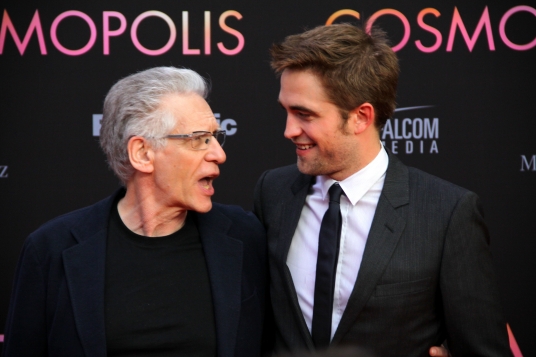
Showing posts with label Cosmopolis. Show all posts

Tuesday, September 22, 2015

New interview from COSMOPOLIS: Robert Pattinson and David Cronenberg Do a New Yorker Accent


David Cronenberg and Robert Pattinson sat down with NY Live for Cosmopolis promo. 


Video by: 1 

If you found this article useful, please share it with your friends on Twitter, Facebook, and Tumblr by clicking the share buttons below. Also, if you liked this blog, subscribe for more!

 Thanks for reading! :) ♥

Wednesday, September 16, 2015

NEW INTERVIEW with @the_talks: How Robert Pattinson Deals with Paparazzi, Refusal for Media Training


Robert Pattinson sat down with The Talks to discuss his new James Dean biopic Life. He also talked about dealing with paparazzi during the Twilight Saga era, people's expectations of him, and refusing to have media training. 
______________________

ROBERT PATTINSON: “EVERYONE WANTS YOU TO BE SO VANILLA”

Mr. Pattinson, are you disillusioned with your career?
I think a lot of actors get disillusioned and say, “Oh, I thought it was going to be one way, and it’s something else.” I never thought anything was going to be any particular way at all! You know, in the good times and the bad times, they’re all just new experiences. So I can’t really be disillusioned with anything because I didn’t have any expectations at all.

What about people’s expectations of you?
I’ve never really acknowledged people’s expectations of me. A lot of actors sort of fall into the job and feel like they’re going to get “found out,” like, found out that they’re a fraud or something like that. I think loads of people feel like that. I did a film with Anton Corbijn called LIFE where I played the photographer who shot those famous photos of James Dean and there are a lot of parallels between an acting career and a photography career.

Like what?
Both of them are almost entirely dependent on the material, especially if you’re doing stuff like taking photos of famous people and really talented people who are incredibly interesting and charismatic. As an actor, you want to be an artist, but you’re so dependent on everybody else! And even if you’re great in something, there’s only a few actors who the audience acknowledges that they were the reason something’s good. With a photographer, it’s very difficult to claim stuff, too.

As someone who has been hounded by the paparazzi more than most, was it cathartic to switch roles and play the photographer for once?
It was quite strange walking up to the Chateau Marmont as a paparazzi. It was very weird at the actual place. I don’t know if it was cathartic. Maybe it would have been if, because of him being paparazzi, he ends up getting beaten to death…

They’re just people, too.
Well… In fact, not at all. That’s probably why my character was so filled with self-loathing, because he’s a paparazzi. (Laughs)

When your career started off you had some trouble with photographers yourself.
When Twilight first happened, a lot of the franchise people at the time were under strict control by the studios and stuff, so they did it quite “kid-friendly.” And I think for the first few months I kept getting photographed, like, being drunk and smoking cigarettes and things. So I think that’s kind of why people said it was a bit different. But I think the landscape has changed so much. I remember even people like Colin Farrell and stuff. I guess when he was super wild, that was only seven years ago, eight years ago, but I don’t even think you’re allowed to be like that anymore.

Why not, what would happen?
If you do that now, you just don’t get employed. At all. Everyone wants you to be so vanilla! It’s so lame! So, everyone’s just like secret drug addicts instead. (Laughs)

Did you have interview training once you signed on to do Twilight to keep all of your comments vanilla?
Yeah, Summit put me in media training because I was doing too many stupid interviews. I just wanted to tell jokes and stuff and then they sent an email afterwards saying that I refused to cooperate with the media training! It’s my agent’s favorite email she got because she thought it was so hilarious that I refused to relent to the media training.

Would it be possible for you to still be friends with a journalist?
I think it works until you get to a certain level of fame. Before the first Twilight came out there were a couple of journalists who I got on with. They did good profiles on you and stuff and they’d kind of champion you for a bit. But I think if you do too many interviews, people aren’t interested in the nuances of what you’re saying. You’ve just said too much and you end up repeating yourself. The editors are like, “Get him to say something that makes him sound like an idiot or get him to say something controversial.”

That’s pretty much exactly how it goes for many publications, sadly.
Yeah and I think you can’t really be that close with a journalist when you can see them, like, needing you to say something bad for their own jobs. I know actors who have made deals with paparazzi and stuff – it always backfires. Always. Because, like, you just shouldn’t. As soon as you start throwing shit around, you’re going to get covered in shit.

Well, after Twilight ended you’ve been choosing to work with auteurs like Herzog, Cronenberg, Anton Corbijn, and James Gray on smaller projects where your exposure is a lot different.
The last few years I’ve basically done stuff just for the director. After working with Cronenberg on Cosmopolis it just opened stuff up. People approach you in a different way. And now I’ve done a few other things and it kind of just works on a roll, being able to work with these auteur-y kind of guys. It’s quite nice to do smaller parts, so the film doesn’t totally rely on what I do in it. I get to work with who I want to work with and it’s not my fault if it doesn’t make any money!

After working with a few of those directors, has there been a moment where you noticed the difference in how they work?
There was a moment at the end of The Rover. We had just wrapped and David Michôd was standing in the middle of the parking lot we were just shooting in. He looked sort of weird and was watching people packing stuff up. And I was like, “You all right?” And he said, “Yeah, I just think I’m only going to have like six more of these days in my life, so I just want to feel it for a second.” It’s so funny the difference between someone who is doing a job essentially for their next job, or somebody who has written it, produced it.

Someone who is going to devote several years of their life to it when it’s all said and done.

Yeah, you can feel it. It’s much more exhilarating and fun to try to fulfill someone’s dream. A lot of the time you’re working with someone and they don’t really know what they want and they don’t even necessarily want to do the job they’re doing. So you’re just trying to not drown and they’re panicking the whole time. It’s horrible. But with people who are confident and believe in their projects, it’s a completely different experience.
_________________

If you found this article useful, please share it with your friends on Twitter, Facebook, and Tumblr by clicking the share buttons below. Also, if you liked this blog, subscribe for more!

 Thanks for reading! :) ♥

Friday, September 4, 2015

NEW Robert Pattinson Interview with Elle France: Calls Twilight a "Happy Accident"

imagebam.com imagebam.com 

Translation
From blockbusters to indie movies, the heartthrob reinvents his career. Starring in 'Life' by Anton Corbijn, he talks about fame, burgers and vampires. We have all dreamed of his fangs planted in our necks. But this fantasy is now over! Robert Pattinson, the sexiest vampires, favorite topic of all the paparazzi since 'Twilight', has completely performed his metamorphosis. Two chic movies with David Cronenberg 'Cosmopolis' and 'Maps to the Stars', then 'The Rover' by David Michod, an amazing road trip in the Australian desert, made him change. As if after the 'Twilight' phenomenon, the indie movies allowed him to affirm serenely his talent in acting. In 'Life' by Anton Corbijn ('Control', 'A most wanted man...), in theaters on September 9, Robert Pattinson plays truthfully the photographer Dennis Stock, a friend of James Dean (we owe him the famous pictures taken in New York and in the farm of Indiana where the 50s' idol grew up). About to fly to Colombia where he will pursue the filming of 'The Lost City of Z' by James Gray, Robert Pattinson talks with us on the phone. The voice is intense, joyful and the laugh is generous. Keep Calm!

ELLE: Allo? Robert Pattinson? 
Robert Pattinson: Yes it's me!

You are one of the most photographed celebrity in the world. Did you enjoy to play a photographer? 
(Laughs) we must put things in context. In the 50s you didn't become photographer like today with mobile phones, it was necessary to have technical knowledge .... It was a job that was practised with nobility.

How did you practised? 
Anton Corbijn gave me a Leica from 1944 and told me: Try to make him a friend, and sees it asan extension of your hand because you will notleave during the shooting!

You took some pictures? 
Yes. It was a disaster. I didn't want to show them to Anton (laughs. Anton Corbijn is a very reputed photographer)

Watching the trailer, we wonder if you would have prefered to play James Dean? 
Absolutely not. Dane DeHaan is pefect for the part. Me, I never had a passion for James Dean. When I was looking for heroes to whom identify myself, James Dean was not one of them. He belonged to another time. I didn't look like him at all. However Dane knew all about him before the movie.

The friendship between the two men is interesting ... 
My character, Dennis Stock, is only 3 years older than James Dean but he lost all his innocence. He is already a father, with responsibilities, his aim is to become an artist. He wants to devote100% of his time to photography, and a wife and children are not part of the journey.

Whereas James Dean is still a teenager ... 
He is a born artist. He is a born artist. The world of children is familiar to him. In any case he shares their imagination. There is this magic scene in the farm in Indiana where my character is taking pictures of James Dean playing with his young cousin. I loved this scene because I had to show the envy and jealousy.

If James Dean was still alive, how would he live his excessive media coverage? 
Badly, of course. What is happening nowadays can make you crazy.

And you? How do you cope with this situation? 
What is terrible is that i became famous when the world changed. In 2008, everybody had a cell phone, it was the explosion of social networks. As results, the margin of freedom to protect the private life has become ultra thin. Not only were all these paparazzi camping outside my house but this new horde of fans who relayed information on social networks. It became unmanageable.

Has your personality changed? 
At some point I became paranoid. I went no moreout of my house in Los Angeles. It was hell. At the same time I was aware of the ridiculousness of the situtation. It made no sense.

What is for exemple the worst thing someone has said about you?
It's going to make you laugh but as a British, to hear someone say I'm American is the worst insult! I am English! Let it be known once and for all!

Does your past relationship with Kristen Stewart has suffered of this? 
I preferred not to broach the subject.

You left Los Angeles to live in London. Is this love that made you change countries? (He is in a couple with the English singer FKA Twigs) 
(Laughs) Actually, i live between Los Angeles and London. But being in London is a pure delight. They leave me alone! It's the same everywhere in Europe. The other day i was strolling around Paris, and nobody bothered me!

Did you get in touch with French directors already? 
Yes! For a great project, but i can't talk about it because it is not signed yet. But I dream of working with her.

So it's a woman? 
Oh my God! I have said enough!

When one speaks of artistic metamorphosis about you, how do you live it? 
It is a bit exaggerated don't you think? There has been what I call "the happy accident" that was Twilight, which allowed me to meet David Cronenberg. Work with him open me up to new opportunities.

And if you were offered another 'Twilight' movie? 
Why not!

By choosing to make indie movies, you were not afraid of losing some fans? 
On the contrary, I think my name on a poster rallies my fan base. I hope to awake their curiosity and show them a different vision of cinema. Don't forget that they grow up too. And they didn't want to see all their lives Robert Pattinson playing a vampire. We tend to devalue the fans. It's a mistake. The fan is an audience member like the others.

Would you say this blockbuster offered you a freedom of action on a platter? 
It's undeniable. Now I am doing what i want. Like doing 'The Childhood of a Leader' with my old pal Brady Corbet. This is his first movie as a director.

It's the movie with Bérénice Bejo, isn' it? 
Yes. She is great. She gave me nutritionnal advice: "Every morning, you can eat and drink what you want. The rest of the day you be careful." I asked him: "Even hamburgers for breakfast?" She said, "No worries, mon petit loup!"

So you are an happy "Englishman in London"? 
Yes! Like never before.

Scans by: therpattzrobertpattinson | Translation by: pattinson-art-work

If you found this article useful, please share it with your friends on Twitter, Facebook, and Tumblr by clicking the share buttons below. Also, if you liked this blog, subscribe for more!

 Thanks for reading! :) ♥

Sunday, August 23, 2015

NEW INTERVIEW: Robert Pattinson Talks LIFE and Taking Cell Phone Pictures with WAZ Online


Robert Pattinson did an interview with WAZ Online to discuss his new movie Life and his life under a photographer's camera daily: 

Mr. Pattinson usually you are hunted by photographers. How does it feel to play a photographer hunting stars in your new movie 'Life'?

I'm playing the young Magnum photographer Dennis Stock, who gets to know James Dean before he became an Icon- no least because of the picture of a moody James Dean in Times Square with a cigarette dangling from his mouth. Stock would have hated it if you called him a papparazzi. He thought of himself as an artist and did everything to be seen as one. That is how I see him.

Okay the times were a little more calm in the 50's. How would you react if someone approached you today and said ‘Hey Rob I want to take a couple of pictures of you’ like Stock did with Dean?

That would be impossible. l would feel like a psychopath would be after me. But it was different back then. There were no cell phones and not amateur photographers, only professionals and they had to find a magazine to publish their pictures. Today the Internet is flooded with cell phone pictures.

How do you deal with the omnipresent cell phone pictures?

A lot of it depends on my mood. lf l’m in a good mood, everything is okay. When l’m not, I do feel bothered. You have to watch out to not get strange and feel persecuted: Then you start to believe that people take pictures of you, who actually have better things to do with their day than do that.

Did you cope well with the media hype of Twilight in your early 20's?

Most of the time I was busy hiding. You are in shock. You don't really understand what is happening. My personal growth was stopped in a way. It was weird: There I was 22 and suddenly I aged 2-3 years. I was working and did a lot of movies during that time. It was madness. My first real break I had after the last Twilight movie.

Is it quieter now? No one recognizes you with your huge beard anyway.

That's true. Now! go to the grocery store without looking around. Fortunately I gained a lot of self-confidence. But l’m still cautious: you don't want drunken pictures of yourself out there.

Meanwhile do you think you were able to shake off the teen heartthrob image?

The real problem was: You are measured according to a weird criteria when you are part of gigantic expensive movies, which are so under pressure to perform. The question always is: How many millions will that movie make? it's ridiculous! You have to watch out not to get stuck in that world.

You must have made enough money to withdraw yourself from that world. Why don't you?

lt’s not that much money. You don't really think about it though. Money is not the primary objective of a young actor. And having enough money is no reason to quit.

What is your goal?

Difiicult to say, but a road is appearing slowly, also with my movie choices. During Twilight l basically pushed the reset button every time and then the next movie would come out.

And then?

I took careful steps into reality. I always strictly distinguished: There was the character that I played in the movies and on the other side my real life.

And today?

Now I try to make more personal movies that have more to do with me and where I have more
control. I'm making movies with authors like David Cronenberg and now Anton Corbijn.

How is it different with them?

They protect you. They don’t let themselves be influenced by others- not like a director who works for a big studio. It may happen that there is a call from above and it's not the directors film anymore but the studios.

And now you open the doors for those authors: Cronenberg said that your name on the Cosmopolis poster brought financing.

Well, l hope the directors do not only pick me just to get financing. I'm also doing very small roles, like in Herzog’s ‘Queen of the Desert’ as Lawrence of Arabia. I don’t believe that an actor is able to guarantee success on his name alone. Those times are over, with a few exceptions though: one of those exceptions is Brad Pitt.

A lot of what you say does sound bitter. Would you wish your success with Twilight on younger people/actors?

Hold on, it was also a great time. Twilight is something very special, if only because of the
enthusiastic fans. My advice for young actors would be to not get overwhelmed and they should
watch out and keep a healthy relationship with reality. If not you can drift easily and are not even
aware of it. So take good care of yourself.
_____________________

If you found this article useful, please share it with your friends on Twitter, Facebook, and Tumblr by clicking the share buttons below. Also, if you liked this blog, subscribe for more!

 Thanks for reading! :) ♥

Monday, July 27, 2015

MENTIONS: LIFE Director Talks Robert Pattinson's Work at the Guanajuato Film Festival


Life director Anton Corbijn talked about Robert Pattinson's work in the film with these media outlets at the Guanajuato Film Festival in Mexico.

Excelsior

“Although many related and pigeonhole the name of Robert Pattinson in the Twilight series, there are others, such as Dutch director Anton Corbijn who see beyond the stigma and / or social labels.

So it is not unreasonable offer made British actor Dennis Stock’s role, that famous photographer 50s that caught James Dean three months before his death in the film Life.

“After I felt Twilight Robert tried to choose characters away from this whole saga.

“He wants to prove to the world that is a real actor can do challenging roles and that reminded me of Dennis Stock, a photographer in his early wanted to check I was good at what he did. That part was something I found in common between the two.

On the other hand, Robert is always being chased by photographers and I liked the idea that the film had to act like a photographer behind a star, he said to questions expressed by Excelsior, Anton Corbijn.

The filmmaker, who likewise attended the Festival last year to promote The most wanted man, was forceful in ensuring that while speaking of James Dean Life is not a movie about him, but the man behind the lens that made him some emblematic images that turned it around the world.

“Whoever thinks that this film is about James, I’m afraid to say that is not so.

“In fact, when I was offered the script I did not care because I did not want to make a film about James Dean, however, when I began to see that the story was more about the photographer, I felt identified because basically that’s what I’ve been doing since 40 years ago, “he said Corbijn.”

There is no release date as yet for Mexico.

El Universal

“For Robert Pattinson after Twilight had shown that he wanted to remove the image of easy film actor, he was chosen to star in Life , directed by Anton Corbijn.

On the tape plays professional photographer Dennis Stock, who came to have a friendly relationship with James Dean, legend of cinema. That closeness was born after the image Stock Dean took in 1955.

“I had noticed that he took papers out of the ordinary ( Bel Ami and Cosmopolis ) wanting to see that it was a real actor; and good in his life he is chased by photographers, and now he must act as one, “the director recalled yesterday. …”

am.com

“Later, the filmmaker opened a a time for questions and answers …. About elect Pattison [sic] for the role of the photographer, he said he and Stock have some in common, at the time Stock sought the recognition, Same with Pattison [sic], who sought the chance to prove he’s a serious actor despite recent films that launched him to fame. He said he was not interested in making a film about the life of James Dean, the script liked by character of the photographer and that is why in Friday night hundreds of people had the opportunity to see the film to be released in theaters later this year.”

La Cronica

“The film, which was presented for the first time in February, within the framework of theBerlin International Film Festival, is an honest portrait of the friendship between the twocharacters which also highlights the performance of Pattinson, “I wanted to work with himbecause in his last films has shown that he is an actor capable of making a complex role beyondmovies like Twilight and has tried to prove that he has more talent and I think that thephotographer of the film is very similar, because you want to prove that it is capable of workingfor a major magazine”, Corbijn explained.

If you found this article useful, please share it with your friends on Twitter, Facebook, and Tumblr by clicking the share buttons below. Also, if you liked this blog, subscribe for more!

 Thanks for reading! :) ♥

Thursday, July 9, 2015

NEW MOVIE ALERT: Robert Pattinson to Star in Josh and Benny Safdie's GOOD TIME

robert_pattinson_h_15

Robert Pattinson will star in neo-grindhouse caper Good Time, directed by Heaven Knows What directors Josh and Benny Safdie. The Hollywood Reporter reports:

The indie film centers on a bank robber’s flailing efforts to evade the dragnet closing in on him. Pattinson will star as Connie. 
Josh Safdie and Ronald Bronstein wrote the script for the film, which will be produced by Sebastian Bear-MCclard of Elara Pictures.
The Safdie brothers, who recently signed with WME, are indie filmmakers whose most recent project, Heaven Knows What, is in theaters. The critically acclaimed film following a young heroin addict (Arielle Holmes) who finds love in the streets of New York was released by Radius-TWC. It won the C.I.C.A.E Award at the Venice Film Festival and also played at the Toronto Film Festival and New York Film Festival.
The directing team’s indie projects include Daddy Longlegs, which played at the 2009 Cannes Film Festival and the 2010 Sundance Film Festival; the doc Lenny Cook, which followed a star high school basketball player and played at Tribeca and Venice before airing on Showtime in February 2014; and their debut feature, The Pleasure of Being Robbed, which premiered at SXSW in 2008 and also played at the Cannes sidebar Directors’ Fortnight before airing on IFC. 
Since starring in the vampire franchise phenomenon known as Twilight, Pattinson has focused his efforts on interesting indie roles. He has worked with esteemed directors including David Michod (The Rover), David Cronenberg (Cosmopolis, Maps to the Stars) and Werner Herzog (Queen of the Desert). His upcoming films include The Childhood of a Leader and The Lost City of Z with Sienna Miller and Charlie Hunnam. He’s repped by WME and 3 Arts.
More info from The Wrap, The Playlist, and the directors:

 Pattinson will play a bankrobber named Connie who is trying to evade the police as they close in on him. Sebastian Bear-McClard of Elara Pictures is producing, while Josh Safdie and Ronald Bronstein wrote the script.
 No word on when it might shoot, but presumably it'll have to wait until Pattinson has wrapped James Gray's "Lost City Of Z" which starts shooting later this year.


See photos and videos of Robert attending the Heaven Knows What premiere back in May HERE.

 Share this post with your friends on social media by clicking the share buttons below. Also, subscribe for more! Thanks for reading! :) ♥

Wednesday, June 3, 2015

NEW/old Fan Photo of Robert Pattinson with David Cronenberg in Toronto

#tbt to exactly 3 years ago. The most surreal day of my life when I had the pleasure of hanging out and having dinner with David Cronenberg (damn the blurry quality but I was too fan girly to pose for a proper one, so I took this creepy over the table "I hope he won't notice" pic) for the premiere of Cosmopolis. Also featured in the left pic a little known actor starring in it. #robertpattinson #tbt #davidcronenberg #cosmopolis #dreamcometrue


If you found this article useful, please share it with your friends on Twitter, Facebook, and Tumblr by clicking the share buttons below. 

 Thanks for reading! :) ♥

LIFE Starring Dane DeHaan and Robert Pattinson Gets U.S. Distribution with Cinedigm - Fall 2015 Release


Good news, Rob fans! Anton Corbjin's James Dean biopic Life, starring Robert Pattinson and Dane DeHaan, has received US distribution by Cinedigm, according to The Playlist:

Following a critically praised premiere at the Berlin Film Festival, Cinedigm (NASDAQ: CIDM) has acquired all U.S. distribution rights to Anton Corbijn’s LIFE, starring Dane DeHaan (Life After Beth; Kill Your Darlings; Place Beyond The Pines), Robert Pattinson (Twilight, Cosmopolis, Maps To The Stars), and Ben Kingsley (Gandhi, Sexy Beast, Schindler’s List ). The film was produced by Iain Canning’s See-Saw Films (King’s Speech, Slow West), and is the second project in an ongoing collaboration between Corbijn and Canning, following their work together on Control. The script was written by Luke Davies (Candy, Lion). 
Corbijn’s follow-up to A Most Wanted Man, LIFE captures the nuances and complexities of the relationship between photographer and subject in a way rarely seen or understood by someone outside the business. In a nod to Corbijn’s own past experience, the film is told from the perspective of the Life photographer Dennis Stock (played by Pattinson) who meets and profiles Dean (DeHaan) for the magazine, turning out some of Dean’s most iconic photographs. 
LIFE will open with a theatrical, digital and television VOD release beginning in Fall 2015. 

“Life gorgeously chronicles the back story behind the 1955 photo spread that brought moody young heartthrobJames Dean to the attention of the American public seven months before his death-,” said Yolanda Macias, Cinedigm’s Executive Vice President of Acquisitions. “Beautiful to look at, powerful to experience, Life, using an Eisenhower-era America as prism, brilliantly presages America’s coming celebrity culture.”
 If you found this article useful, please share it with your friends on Twitter, Facebook, and Tumblr by clicking the share buttons below. 

 Thanks for reading! :) ♥

Friday, May 29, 2015

NEW/old Fan Photo of Robert Pattinson in NYC After Filming with Dior - December 2012

technadeschanel: #TBT me with #RobPattinson 3 years ago. #TwilightSaga #TwilightSagaBreakingDawn #twilight #TwilightSagaEclipse #TwilightSagaNewMoon #RememberMe #Cosmopolis #WaterForElephants #celebrity #nyc #actor #throwback #Thursday #ThrowbackThursday

Rob's face!! LOL 

If you found this article useful, please share it with your friends on Twitter, Facebook, and Tumblr by clicking the share buttons below. 

 Thanks for reading! :) ♥

Saturday, May 2, 2015

#RobPattinsonBdayWatchAlong: Celebrate Robert Pattinson's 29th Birthdaywith a WatchAlong!!

Update: 
Movies for the watchalong are:


RKMovieNews did a really nice job making these posters for the watchalong. Hope to see you guys there this Saturday and Sunday! :) 

Original Story: In honor of Robert's 29th Birthday we (including RK Movie News and Stewartboxd) will be having a marathon of movies on Saturday, May 16th and Sunday, May 17th. We automatically included The Rover, Cosmopolis, Bel Ami and Remember Me as they are readily available on Netflix and Amazon Prime. We also included Maps to the Stars as it was recently released on DVD/BluRay but we need your help to pick the remaining three films. Please vote in the following poll on the sidebar to select the movies you would like to watch.


 If you found this article useful, please share it with your friends on Twitter, Facebook, and Tumblr by clicking the share buttons below. 

 Thanks for reading! :) ♥

Monday, March 9, 2015

David Cronenberg Mentions Rob, 'COSMOPOLIS', and 'MAPS TO THE STARS'

Cosmopolis Premiere in Berlin 

Q: You and Robert Pattinson have developed an interesting creative partnership. You’re a bit of an odd couple.

Cronenberg: We are. Well, first of all, I think he’s a really good actor, and I think he was an underrated actor because of the stiffness and silliness of Twilight and those characters in it. But seeing other work that he had done and seeing that he was a serious actor and looking for challenges, and wasn’t trying to “manage his image” as a star, was attractive to me. And, of course, being such a big celebrity is helpful because it will help your film get financed, but the charisma that made him work so well as Edward Cullen is something you want in a movie like Cosmopolis where he’s in every scene in the movie. You need someone who’s infinitely watchable. But once you’re on the set, he’s just a sweetheart. Totally professional, really accessible, and funny. And a terrific actor.

Q: So I take it you’re not a fan of the Twilight movies.

Cronenberg: Well, no, of course not. Look, the series is a huge hit, of course, but it’s young adult fiction and I’m not a young adult. If people are mesmerized by it you can’t argue with it. Not a lot of movies and series have that kind of following. I don’t fault it for that.

Q: Right. Twilight also had a strange chastity/sex is evil message.

Cronenberg: Yeah. And you can be sure that Rob was aware of all those things. He’s very well-read, and very well-versed in cinema—which I’m not sure his fans know. He was very hyper-aware of all those things surrounding those movies.

Q: Your film does have a fun sex scene between Julianne Moore and Robert Pattinson in a limo.

Cronenberg: That was fun to shoot! It requires some athleticism to have sex in a limo for all concerned—including the cameraman—but obviously this isn’t the first time I’ve done a sex scene in a limo, since we did a bit of it in Cosmopolis. In this case it was a real limo, but in Cosmopolis it was a limo-set.

Q: Well Robert seems to have the limo sex thing down, now.

Cronenberg: [Laughs] I’ve never asked him how many times he’s had sex in a limo for real. It’s not really my place to ask such a thing. It really just requires the characters to be good actors. Obviously, the sex had a very different tone in this movie because he’s not the star—she’s the star in this movie. He’s just servicing her, and he knows that he’s doing it for his career—he thinks. Whereas in Cosmopolis, he’s the emperor of his limo.

___________________

You can read the rest of the interview HERE.

source
via thinkingofrob

If you found this article useful, please share it with your friends on Twitter, Facebook, and Tumblr by clicking the share buttons below.
Thanks for reading! :) ♥ 

Tuesday, February 24, 2015

NEW Rob Interview with Yahoo Singapore (LIFE Berlinale Press Junket)


EN Interview 1 - Ever since the Twilight films turned him into an object of mass attention, Robert Pattinson has tried to find his way clear of fan obsession and make his mark as a serious actor. Films like Cosmopolis and Bel Ami helped distance audiences from his vampire alter ego, and now, in Anton Corbijn's Life, Pattinson gives what is arguably the best performance of his career. The 28-year-old heartthrob plays Dennis Stock, the photographer whose iconic photos of James Dean during the last months of his life have sustained the actor's legend even more than his films.

"James Dean is very much an iconic figure to me," Pattinson says. "He represents disaffected youth and alienation in a powerful way that still resonates with us. Those photos of Dean, like the one where he is walking in Times Square, are much more part of our image and impression of him than his films. You can feel his aura and mystique in those photos."

It was an ironic choice of roles for Pattinson who was able to experience what life is like on the other side of the camera lens: "When you're on the red carpet, it's an eerie experience because you don't see the photographers because you're blinded by the lights and flashes most of the time! As a photographer, you get to hide behind your camera."

One of the hottest films at the recently concluded Berlin International Film Festival, LIFE explores the parallel lives of James Dean - played by Dane DeHaan - and Dennis Stock (Pattinson) while the latter was on a road trip taking photos of Dean as part of an assignment for Life Magazine, one of the most popular magazines of its era. The photos subsequently became the stuff of legend and posters that young people would put on their walls as a symbol of youthful rebellion and cool.

Pattinson not only understood something of how James Dean must have felt when his career skyrocketed within a very short time in Hollywood, but also how today's stars - Pattinson included - are so overexposed that they lose all mystery.

"People didn't know that much about Dean's private life and those photos that Stock took of him had so much more impact and meaning than anything you could imagine today," Pattinson muses about the work of the photographer who passed away in 2010.

For director Anton Corbijn, the film also has a deeper meaning in that before he became better known as a filmmaker, he achieved considerable fame for his NME photo shoot of Joy Division frontman Ian Curtis shortly before he hung himself. Like Stock did with his photos of Dean, The images of Curtis taken by Corbijn have in their own way amplified the legend of the fabled singer and Corbijn subsequently directed the film Control which depicted Curtis's dark and difficult life.

Wearing a fairly lush beard and looking pleasantly disheveled, Robert Pattison was greeted by adoring crowds during his stay at the Berlin festival. He was wearing a grey Armani jacket and jeans for our chat at the five-star Hotel de Rome.

In addition to Life, audiences will see Pattinson play Col. T.E. Lawrence in Queen of the Desert, a film starring Nicole Kidman and directed by Werner Herzog.

THE INTERVIEW

Q: Robert, it must have been inspiring to play an iconic photographer like Dennis Stock?

PATTINSON: His photos have played a huge part of our collective consciousness of James Dean and the myth that still surrounds him 55 years after his death. Almost everyone has seen some of those photos and so many people including myself have been influenced by our image and perception of Dean and how he represents disaffected youth. Dean is still one of the key figures who represent a kind of defiance and rebellion and someone who felt the confusion of being young and not wanting to conform or stick to the rules. There are very few photographers who have been able to capture that kind of mystique the way Dennis Stock did.

Q: How did you relate to Dennis Stock and his work as a photographer?

PATTINSON: What fascinated me was that he was an artist who was struggling with living up to his own expectations of what he should be doing as an artist. He doesn't feel he's accomplishing enough or doing the kind of work he wants to be doing. I've spent a long time dealing with the same kind of issues and trying to attain goals that I've set for myself and wanting to do the best work possible. I'm still very driven to do work that challenges me.

Q: Did you go through a James Dean phase in your younger days?

PATTINSON: (Laughs) I think almost every actor has a moment in their live when they are either obsessing over James Dean or trying to imitate some aspect of his personality or his acting style. I was a fan of his even before I wanted to become an actor. We all want to look as cool as he did although it's pretty much impossible! (Laughs) I admire his work greatly although I don't think I'm anything like him and I wouldn't dare to compare myself to him.

Q: Would you have wanted to play Dean yourself?

PATTINSON: No! I wouldn't have dared. And I think Dane (DeHaan) does a brilliant job.

Q: What kind of research did you do to prepare for the film?

PATTINSON: Anton (Corbijn) showed me a taped interview with Dennis Stock in which he was very rude to the interviewer. He was always a very complex figure and he had a lot of anger inside because he was very ambitious and wanted to make his mark as an artist. He was very jealous of other artists.

I also spent several months learning to use a camera and work with cameras the way a professional photographer would use them. I took a lot of photos and practiced the kind of movements a photographer makes while working. For a photographer, the camera is basically an extension of his body and he hides behind it while he's taking photos.

Q: Dennis Stock was very conflicted about his work. Were you the same way?

PATTINSON: I've suffered from a lack of self-belief. You worry that you're just faking it and people will start to see through you. So that fear keeps me going and inspires me to take on as many challenges as I can. I was making things much more difficult for myself by constantly worrying about my work and then I started to realise that I just had to simplify my approach and let my instincts take over. I feel a lot more confident now but I still have enough doubts that make me want to keep improving and evolving as an individual and as an actor.

Q: This kind of movie addresses the issue of celebrity and how an actor becomes larger than life. You've experienced that with your work as Edward Cullen in the Twilight films. How have you transitioned past that part of your career?

PATTINSON: It's become a lot easier as the years have gone on. It's not just that it's been a few years since the last Twilight, it's also that I've become a lot better at handling the attention.
One of the interesting things about the film is that it deals with how someone like Stock can block himself and stand in his own way because of his fears and jealousies. He wanted to be seen as an artist in the same way that Dean was and this was a complex issue for him. I've also dealt with my own anxieties in terms of what I wanted to achieve and my own artistic goals.

Q: How do you feel that process is coming along?

PATTINSON: I feel like I'm where I want to be. I don't feel frustrated anymore by the legacy of Twilight and the fact that I've been identified with my work in those films. I knew that it was going to take some time before people would be able to see me in a different way and that I would have to play a lot of different roles to shake up people's expectations of me. It's normal because of the massive success of those films. But in the long run I've tried to benefit from the attention I gained and find as many interesting roles as I can. I think people are beginning to see me differently now.

Q: Has there been any one film in particular that's helped you feel that you're on the right track in terms of your career?

PATTINSON: I was kind of drifting and unsure of what kinds of films I wanted to do until I did Cosmopolis with David Cronenberg. He offered me the role out of nowhere just a few weeks after I had finished the last Twilight film and suddenly I was thrown into this incredible story and playing a very complicated character. That changed my perspective and I knew that this was the kind of work that I wanted to do. It made a huge difference to me.

Q: Is it easier being Robert Patttinson now?

PATTINSON: (Laughs) I don't know... but I'm having a lot more fun now. You need to get past all the things that are holding you back and then everything starts becoming a lot easier in general.


If you found this article useful, please share it with your friends on Twitter, Facebook, and Tumblr by clicking the share buttons below.


Thanks for reading! :) ♥

Monday, February 9, 2015

NEW Rob Interview with RBB-Online: "I'm exactly where I wanted to be"


I´m exactly where I wanted to be.

Even after two Cronenberg-movies many still doubt the acting skills of Twilight-star Robert Pattinson. On Monday he presents his latest movie “Life” at Berlinale – together with director Anton Corbijn. In this interview the former vampire-star explains how he connected with the movie and why he feels his career is in a good place.

Q: Mr. Pattinson, is James Dean still an icon to your generation?

RP: Definitely. Especially when I was young. I knew James Dean before I even knew I wanted to act. I had read many of his interviews. He was style-defining and has an influence on every actor, simply through his physicality. Anyone who´s leaning forward, trying to look cool, is copying James Dean, really (laughs)

Q: You playing a photographer has a certain irony since in real life you often clashed with photographers who sometimes made your life hell. What was it like, playing a photographer?

RP: They´re still doing it. But to be honest, I had a very preconceived notion of photographers. Just like Anton Corbijn. Our ideas couldn´t have been more different. For Anton, the whole movie is about the nature of the photographer. I didn´t see Dennis Stock as a photographer, but someone, who under all circumstances wanted to be an artist. He saw an artist in James Dean just like he saw himself as an artist. To me the movie is about those petty jealousies: why is Dean perceived an artist and not me. That´s what I liked about it.

Q: As an actor, you offer up a lot of yourself and at the same time hand over responsibility to the director. How do you handle the fact that you can influence the final product only indirectly?

RP: It´s always a bit of a gamble, but also a matter of trust. I had talked to Anton Corbijn for an hour a year before we started shooting. I had only skimmed the script half an hour before our meeting, I wanted to impress him. He could have told me anything. Just when we started shooting I got a feel for the story.

Q: What did you like about the movie?


RP: The movie has a strange tone, it´s about so many universal things, but also very personal. For instance, it focuses on the situation where as an artist, your standing in your own way, blocking yourself and do not exploit your full potential. That´s something I can relate to.

Q: Do you stand in your own way often?

RP: Many actors often get the feeling that they´re just faking things and are afraid that some day someone realizes that they can´t act at all. That fear keeps me from many things that I actually want to do. And Dennis Stock, too, instead of believing in himself, comes up with one excuse after another as to why he´s not the right guy for the job. I could identify with that.

Q:Where do you get your self-confidence as an actor?

RP: I stopped thinking about it and just do it. Often I worry afterwards but since it´s to late then, it doesn´t really matter. And I always remind myself that I actually really enjoy what I´m doing.

Q: It´s been ten years since you started your career. Time for a resumee. How satisfied are you with your career?

RP: In fact I´m exactly where I wanted to be. After Twilight I knew it would take a while to get to the next level but I´m gradually getting there. Of course I´m always trying to get better as an actor, but so much depends on the stuff you get offered. Acting is of course the outline, but every director offers you different possibilities.

Q: What was it like for you when the Twilight Saga ended?

RP: I had no idea what to do with myself and then came the offer for Cosmopolis, right out of nothing, three weeks before we finished shooting Twilight. It changed everything. All of a sudden the movies I like are within reach for me as an acto

source
Thanks to rplife for the info.

If you found this article useful, please share it with your friends on Twitter, Facebook, and Tumblr by clicking the share buttons below.
Thanks for reading! :) ♥

Wednesday, February 4, 2015

LIFE Production Notes: Quotes on and from Rob

Here are the full production notes from Life, featuring Rob, co-star Dane Dehaan and Joel Edgerton, director Anton Corbijn, producers Iain Canning and Christina Piovesan, and screenwriter Luke Davies. 
Rob's quotes are in bold, quotes about him are in bold italics. 


CASTING

Robert Pattinson plays photographer Dennis Stock. He was attracted to the project as “an interesting period in history and an interesting take on such a massive character as James Dean.” Pattinson says, “I read the script for quite a long time before I decided to do it,” and he was impressed by the “elegant, poetic telling of the story.” The idea of co-starring with an actor his own age was also appealing, and Robert met with Luke Davies and Anton Corbijn to discuss the film. However, he says,“My decision was so dependent on who was playing Jimmy.” Robert notes that a director of Anton’s calibre would not have cast a mere “James Dean look-alike,” but he wasn’t fully committed until Dane DeHaan came on board. (As for the idea of playing James Dean himself, Robert laughs: “Oh no. Not in a million years. Dane’s brave.”)

And just as Anton and the producers knew they wanted DeHaan, they were equally convinced of Pattinson’s part in the film. Anton recalls, “Rob was quickly on the horizon for me, and after we met I didn’t meet anyone else for that role.” The director also liked that Robert and Dane “are such different actors, and that’s a great thing for the roles they play” since the characters contrast “and you can imagine they could be friends because they’re different and that’s interesting in friendships—you offer the other person something that they don’t have.”

Writer Luke Davies said the casting was “dream news.” He describes Pattinson’s performance in The Rover as “incredible,” and he knew Robert would be perfect for the part of Dennis. And Dane DeHaan comments, “I really respect Rob’s bravery in jumping into films like this. He continues to challenge himself as an artist, and I’m glad I could go on this particular journey with him.” 

Iain Canning observes that Pattinson “is not interested in following a sort of matinee idol concept, he really wants to play characters that are multi-layered and complicated.” Canning finds it “very interesting that Robert Pattinson’s playing a photographer taking a photograph of somebody who is on the cusp of stardom given what has happened to him in his life and his early fame through the Twilight films.” Christina Piovesan remarks on the circumstance as well: “As a young actor who has been at the center of all these photos all the time, now he gets to play the other side. It’s so exciting.”

Robert took the photographic element of his role seriously. Iain says, “Rob has been obsessed about the details of the photography and getting it right.” Robert discusses that attention to his character’s art: “A few months before production, I started shooting on the same Leica that Stock had.” He describes traditional photography as a dying art and says, “There’s something quite gentle about it compared to digital photography because you can’t force a picture. You can’t shoot as if you’re on an iPhone and just put a filter on it afterwards.” Robert even went to the Leica office in London for guidance but says,“it takes a long time to be able to take even okay pictures, let alone good ones.” Still, he wanted to understand his character’s world, both the professional and personal experiences.

Canning remarks that “In embodying the role, Rob has grappled with how important it is to understand the emotional dynamics of Dennis at the time, to understand that it was an era whereby men of twentyseven were expected to have settled down, to be living a certain life, and Dennis Stock wasn’t living that life.” Dennis was struggling with where he fits in in the world. Canning remarks on the energy Robert brings to his performance, “a beautiful mix of empathy” and “vulnerability” in his character’s resistanceto “the expectations of settling down and living your life in a certain way” and “how emotionally complicated it is to be a good father.” The character is grappling with the price of success and weighing it against the value he placed on fatherhood.

Robert was intrigued by the conflict and Stock’s rejection of his parental role: “I liked that Dennis Stock is written as being quite a bad dad. Regardless of the period or of James Dean, in a movie you don’t normally see a guy who had a kid pretty young and thinks it’s restricting his life as an artist, or whatever it is that he wants to be, and is very open about it. It’s quite frankly dealt with in the script.” Pattinson adds, “the idea of having a seven-year-old kid is interesting for me. That doesn’t happen very often for people my age.”

Dennis also questions his professional role. Robert says, “He was a step above a paparazzi and forced for financial reasons to be a commercial photographer, and he doesn’t really have any artistic flexibility in his work. He just does what he’s told, and it’s kind of suffocating him. He’s been in L.A. for a while and is beginning to think that he’s wasting his life. He’s approaching thirty and he hasn’t proven anything, doesn’t have any money, and he’s abandoned his family in New York.”At the same time, says Robert, Dennis has a degree of professional status. “The world wasn’t so saturated in images of celebrity, so the images in LIFE magazine were heightened, and they weren’t trying to knock celebrities down in the photos. There was a fascination for people, and I think the subject could trust the photographer a lot more.”

But gaining James Dean’s trust was still part of Dennis’ challenge. Ultimately Jimmy gave Dennis a lot of access, but it took time. The effort was worth it. Robert says, “Dennis realized how famous Jimmy was going to become quicker than Jimmy did.” It was a great professional opportunity for him, though Robert says, “I think Dennis’s biggest problem is he can’t appreciate his own work. He was taking good photos before he met Jimmy, but he just didn’t regard them as anything worthwhile and wasn’t being rewarded for them.” The photo assignment was going to bring Dennis acclaim, but perhaps more importantly, at a personal level, “because Jimmy likes him and gives him approval of the photos, it allows him to think of himself as an artist because he respects Jimmy’s work so much.”

Full Production Notes

Telefilm Canada, Film4, Screen Australia, Filmförderung Hamburg Schleswig-Holstein Present

LIFE

In association with FilmNation Entertainment, Corner Piece Capital, Entertainment One, The Harold Greenberg Fund, Cross City Sales

A See-Saw Films, First Generation Films, Barry Films Production

A Film by Anton Corbijn

ROBERT PATTINSON

DANE DEHAAN

JOEL EDGERTON

ALESSANDRA MASTRONARDI

STELLA SCHNABEL

and BEN KINGSLEY

Directed by
ANTON CORBIJN

Screenplay by
LUKE DAVIES

Produced by
IAIN CANNING
EMILE SHERMAN
CHRISTINA PIOVESAN

Produced by
BENITO MUELLER
WOLFGANG MUELLER

Line Producer
STEVE WAKEFIELD

Executive Producers
TESSA ROSS
MARK SLONE
MICHEL MERKT

Executive Producers
MARK ROBERTS
SHELDON RABINOWITZ
ROSS JACOBSON

Director of Photography
CHARLOTTE BRUUS CHRISTENSEN

Production Designer
ANASTASIA MASARO

Editor
NICK FENTON

Music by
OWEN PALLETT

Hair Designer
VINCENT SULLIVAN

Make-up Designer
DONALD MOWAT

Costume Designer
GERSHA PHILLIPS

Casting by
LAURA ROSENTHAL

Canadian Casting by
JOHN BUCHAN C.S.A. and JASON KNIGHT C.S.A.5

LIFE

PRODUCTION NOTES


Anton Corbijn (A Most Wanted Man, The American, Control) presents LIFE, produced by See-Saw Films First Generation Films and Barry Films. From a script by Luke Davies (Candy) the film stars Robert Pattinson (Queen of the Desert, Maps to the Stars, The Rover, The Twilight Saga), Dane DeHaan (Kill Your Darlings, The Place Beyond The Pines), Joel Edgerton (The Great Gatsby, Warrior), Alessandra Mastronardi (To Rome with Love, Romeo and Juliet) and Ben Kingsley (Selfless, Iron Man 3, Hugo).

Inspired by the true story of a friendship that developed between Magnum photographer Dennis Stock (Pattinson) and actor James Dean (DeHaan) when Stock was commissioned to photograph the actor for LIFE magazine in 1955.

Stock was 26 and old before his time when into his buttoned-down world came fledgling star James Dean, a free spirit who would change popular culture from suits to jeans and from matinee idols to teenage heartthrobs. The assignment for LIFE magazine, which took the pair on a photographic journey across the US, from LA to New York and on to Indiana, would change Stock’s life and produce some of the most iconic images of the age.

LIFE is produced by See-Saw Films’ Iain Canning and Emile Sherman (Shame, Tracks) with Christina Piovesan of First Generation Films (The Whistleblower, Amreeka) with Wolfgang Mueller and Benito Mueller of Barry Films. LIFE was filmed on location in Toronto and Los Angeles. The creative team includes director of photography Charlotte Bruus Christensen (The Hunt, Far from the Madding Crowd) production designer Anastasia Masaro (The Imaginarium of Doctor Parnassus, Mama), costume designer Gersha Phillips (House of Cards, The Whistleblower) and editor Nick Fenton (The Selfish Giant, The Double). The film is financed by Telefilm Canada, Corner Piece Capital, LLC, Film4, Screen Australia, Harold Greenberg Fund, Michel Merkt and Union Bank, N.A in association with eOne Entertainment. FilmNation Entertainment is handling international sales.

SYNOPSIS
(from Luke Davies)
Young photographer Dennis Stock tries to pin down rising actor James Dean in order to give a LIFE magazine assignment more weight than that of a simple puff-piece. However, when Jimmy is not reluctant, he’s chaotic, swept along by joy, play and mischief. And when Dennis is not annoyed, he’s exasperated, trying to get the elusive Jimmy to focus—or even to show up. From the frenetic energy of New York, the two head back to the heartland—to the Indiana farm where Jimmy grew up—in order to record something of Jimmy’s roots. Dennis thinks he’s capturing a star in the moment before he breaks; in fact, he’s documenting the last moments of intimacy and simplicity that James Dean will ever know. In the process of the journey from Hollywood to New York to Indiana, a deep affection and improbable friendship gradually develops between the two young men.


LIFE’S GENESIS:


More than half a century after James Dean’s death, he continues to fascinate. His life and death are the stuff of legend. But See-Saw Films did not set out to create a generic biopic either to celebrate the myth of James Dean or to refute it. The film-makers saw another possibility behind the icon—a story about friendship and cultural change. Two artists met: one a successful establishment photographer and the other a rebellious actor on the cusp of greatness and tragedy. Their uneasy relationship developed into a camaraderie that produced iconic images of a new generation of discontented youth and a new breed of film star.

The story See-Saw tells emerged from patient research into the lives behind the myths surrounding their subject. Producer Iain Canning observes, “There can be an instant excitement about the idea of doing a film about a real person, but that doesn’t necessarily mean that there’s a story worth telling…. We went through a very heavy research phase, sifting through the myths and trying to get to the truth of the story while also making sure that it was emotionally interesting or dramatically interesting enough for us to start developing into a feature film.”

Luke Davies undertook the research and writing that became LIFE. He had worked with See-Saw producer Emile Sherman on a film adaptation of Luke’s book Candy, and he knew Iain and Emile well. Luke’s own early life story and writing had brought the collaborators together and sown the idea for pursuing an artist—actor, musician, writer, photographer—as film subject. James Dean was discussed, and Luke took on the project. “I immersed myself in every single piece of information about James Dean,” says Davies, “and in the end I had the broad stretch of his short life”. But one part stood out: 7 Dennis Stock’s photo assignment trip with James Dean. Luke shared the idea with See-Saw. “That’s our movie,” said Iain. In 2010, Luke started writing the script. It became not a full biopic with a grand sweep, but “a short arc with grand themes,” says Davies.

Luke continued his investigation into Dennis Stock and the background to the famous Times Square shot of James Dean. His research included interviews with people connected to the story, including Magnum executive John Morris (played by Joel Edgerton) and Dennis Stock’s son Rodney, who was seven at the time of the story. As he gathered biographical detail, he made a serendipitous discovery: “Act one, Los Angeles. Act two, New York. Act three, Indiana,” says Luke. “And going back to Indiana is like a journey into Jimmy’s past. Indiana represents traditional America of that era, and there is a tension between the farm and the world of fame.” Davies sees “an incredible turning point in the American zeitgeist” captured in the mix. Here were the origins of the sixties revolutions to come. As Luke observes, “the kids who were fourteen and fifteen years old in 1955 watching Rebel Without A Cause“ saw themselves represented seriously and saw a foreshadowing of the coming cultural changes they would initiate.

“As for finding the right film title, Davies says, “This one was instant. There was never another title.” Dennis Stock is working on a LIFE magazine assignment, and life choices are at the heart of the story. Says Davies, “In a sense the movie is at some deeper level about how mortality should affect the way that we choose to live here and now. So it’s a celebration of life and an elegy for James Dean’s death.”

With a thoroughly researched, well-written script in place, the development process continued. Iain and Emile approached Christina Piovesan about co-financing the film and producing it in Toronto. She had worked with the See-Saw producers before. Christina says, “Emile and Iain are among the most creative and insightful producers out there. Iain’s creative and narrative skills are so honed, and it was a great opportunity to collaborate with producers who are absolutely at the top of their game.”


THE STORY

It is hard to imagine the James Dean story without the images Dennis Stock captured. Chance played a role in bringing together the two young men. Dean resisted Stock’s photo assignment until some trust was formed and then only months later Dean was killed when he crashed his Porsche Spider, just after filming Rebel without a Cause and Giant. Dennis Stock’s photographs of Dean appeared in Life magazine and he went on to have a long career living into his eighties, and James Dean became a legend. Now the personal story of that remarkable photo assignment is told. LIFE explores the genesis of and layers behind Stock’s famous pictures, published the day before the Times Square premier of East of Eden and James Dean’s overnight stardom. It humanizes the person behind the James Dean myth and reveals a conflicted young artist who resists the attempts of the industry to turn him into a star. It also personalizes the other man—the artist and documentarian behind the lens and instrument of fame. The authenticity of their story resonates in an era of celebrity culture, manufactured recognition, and cameras everywhere.

The photography from that 1955 trip permanently fixed the image of James Dean and heralded the emerging youth culture. A generation gap was growing, but much of the tension in LIFE comes from the differing sensibilities of two young people. Iain Canning notes that “James Dean was a catalyst in popular culture, for people feeling it was acceptable to take a slightly different route in life, but for the Dennis Stock character, because he has had a family life and because that family life didn’t go to plan, he is looking at this young person and wishing he could turn back the clock.” However, Dennis is “not able to be in the moment” the way that Jimmy is. Stock is struggling with the expectations of fifties conformity, while Dean is comfortably rejecting convention. Stock has been following the socially prescribed script: marriage, career, parenthood. However, he is dissatisfied. His marriage has failed, and he has fled his parental responsibility. But he is still in pursuit of conventional success and works for corporate interests. Luke Davies points out that “Dennis is the hot young photographer for LIFE Magazine, which is read by thirty million people a week, and Jimmy’s a young actor who has made a handful of half hour TV shows and is in a movie that’s about to be released and might make him famous. So at this exact point in time, Dennis is the more socially powerful character, not Jimmy, and for Jimmy it’s this kind of bargain with the devil.”

LIFE captures James Dean’s dilemma. He desires success as an actor, but he wants to maintain his integrity, and he senses “the power of Warner Brothers and publicity and so on and has very ambiguous feelings about it,” says Davies. He wants the opportunities but with independence, and he would like to elude the celebrity machine. “So Dennis is the kind of person who Jimmy’s trying to avoid,” which doesn’t make sense to Dennis—“who wouldn’t want to have their photos take for LIFE magazine?” Davies calls it “a cat and mouse game” between Dennis and Jimmy. There is friction between them. Dennis sees a professional opportunity, and James fears a professional trap. Cultural tensions play out in the relationship, and the story of their friendship is one of reconciling differences and finding common ground. Eventually, they move toward what Davies calls “a kind of tentative affection” and “by the end of the film, each gives the other a profound gift about how to live. It’s always tinged by the sadness that James Dean is going to die, but it makes the gift no less valuable.” Canning remarks, “We see through 9 this story how James Dean manages to get Dennis to open up and to embrace life in some ways, and then how James Dean is able to embrace the conflict of the commerce and the art of Hollywood.”

Canning remarks, “We live in a different age now. The documentation of celebrity has radically changed from the time when Dennis Stock was taking photographs to the current situation, and I think that in some ways the film celebrates that freedom in that Dennis Stock went on this sort of friendship trip with James Dean in L.A. and New York and Indiana, but it was just them together going off and taking these photos. It wasn’t as pre-planned or as organized or as complicated perhaps as today, and that’s very much a story of then versus now.” Canning believes that from Dennis Stock’s perspective, the trip was about “documenting this person’s spirit in some way, not capturing a stolen moment but capturing a moment through getting to know the subject, caring about that subject, and understanding them better.” It is the kind of work that has made Anton Corbijn’s work as a photographer celebrated.

ENTER ANTON

In part, Iain Canning’s inspiration for a project like LIFE came from working on Anton Corbijn’s Control, a biographical film about Joy Division’s Ian Curtis. Their association continued. Anton’s renowned career began in photography with his influential work in rock music, from which he moved into music videos and then feature films. Having set up their production company See-Saw, Iain and Emile worked with Anton on projects with Depeche Mode, U2 and Coldplay. While developing their project on James Dean, they saw a natural connection for Anton.

Iain comments, “I think there’s a lot of common ground between Control and LIFE because they both bring Anton to the core of what he’s known for outside of film.” That common ground is photography and the influence of the photographer on the subject. Anton knew well the personal and creative relationships that can emerge, and in making Control he drew on his history of photographing Ian Curtis and Joy Division. He seemed perfect to direct LIFE, “a story about a photographer who works with either actors or musicians in terms of bringing out their soul and their spirit,” says Iain.

Christina Piovesan had worked with Corbijn in Montreal on a music video for Arcade Fire’s song “Reflektor” and says, “I spent hours in the car with Anton as we were location scouting, and he would tell me these amazing stories about all the people that he’s met and photographed.” Anton is “a worldrenowned photographer who has experienced what the film is about in his own life as a photographer” She thinks the film spoke to to him profoundly. “I remember seeing him talking to Rob in the dark room where he, as Stock, is developing the iconic photo of James Dean in Times Square. Anton was guiding 10 Rob through that scene and he was just so animated and seemed to feel so at home in that dark room. It was exciting to see how he was communicating his passion to Rob.”

Canning notes, “What struck a chord for Anton, was the story of how a photographer can go on a journey with an artist and end up defining the iconography of that artist.” In addition, Dennis Stock’s photo assignment occurred the year of Anton’s birth, 1955, and Canning suggests that Anton felt an attraction to
the idea of the photographer-artist relationship forming at the beginning of his own life. The stars seemed to align.

Luke Davies was thrilled when Anton came onboard. He was a fan of Control, and he recognized that LIFE connected with “Anton’s background and passion” because “he started life as a photographer, so he really understood Dennis’ character.” With Anton’s strong vision for the film, Luke knew his script was “in safe hands.” Dane DeHaan and Robert Pattinson echo admiration for Control and confidence in Anton. Says Dane, “He’s a soft-spoken person, but he’s meticulous about the shot itself, and you leave knowing that the film is going to be shot beautifully.” Dane describes Anton creating a reassuring atmosphere of calm, and Robert comments on the “formal elegance to the way Anton shoots things.” “He knows the movie he wants to make,” says Pattinson.

Anton wasn’t initially interested in doing another biographical project, but he wanted to work on subject matter less dark than his previous films, and Iain brought him the “very well-written script” of LIFE. As well, Anton notes “the fact that Stock was a photographer photographing an interesting person who’s well known and who was in the arts. That’s kind of what I do.” Anton’s own career was forged from the close working relationship he established with Dutch musician Herman Brood, who became Holland’s biggest rock star ever. Anton’s photographs were instrumental in Brood’s fame and he remained friends with the musician, as Dennis Stock might have done with James Dean had he not so suddenly died; however, Anton says, “I related to the story of being a young photographer starting out with someone whose career skyrocketed and left me behind.”

Anton, of course, has achieved his own fame, but he works behind the camera, so he relates to Dennis Stock. (They even share a common inspiration in photographer W. Eugene Smith, one of “the old masters,” says Anton.) He was drawn to the project and committed to it despite a tight schedule—Anton was still working on A Most Wanted Man a month before starting LIFE. “It’s new for me to have films that close to each other, but I think we did very well...it feels like we have something special.” From Anton’s perspective, the strength of the film isn’t merely the James Dean material: “It is really the story 11 of Dennis Stock. We see it mostly through his eyes...and a lot of emphasis is placed on his side of the story and how he experiences this friendship.” The photographer and the actor share the stage in LIFE. Anton observes that “Jimmy and Dennis learn from each other; Dennis gets to look a little bit differently at his relationship to his son, and for James Dean it was quite interesting to have a friend with his own opinion, not a yes man. I don’t think Stock was that kind of guy.” As for the real people portrayed, Anton acknowledges a sense of responsibility for accuracy but also points out that his work is creative: “obviously you want to stay close to the real person and at the same time it’s a film. In a film you always search for some kind of drama, but you don’t try to make a terrible person nice and vice versa. You try to give people depth to their character and motivations.” But it takes great actors to realize a director’s vision.

CASTING

Robert Pattinson plays photographer Dennis Stock. He was attracted to the project as “an interesting period in history and an interesting take on such a massive character as James Dean.” Pattinson says, “I read the script for quite a long time before I decided to do it,” and he was impressed by the “elegant, poetic telling of the story.” The idea of co-starring with an actor his own age was also appealing, and Robert met with Luke Davies and Anton Corbijn to discuss the film. However, he says, “My decision was so dependent on who was playing Jimmy.” Robert notes that a director of Anton’s calibre would not have cast a mere “James Dean look-alike,” but he wasn’t fully committed until Dane DeHaan came on board. (As for the idea of playing James Dean himself, Robert laughs: “Oh no. Not in a million years. Dane’s brave.”)

And just as Anton and the producers knew they wanted DeHaan, they were equally convinced of Pattinson’s part in the film. Anton recalls, “Rob was quickly on the horizon for me, and after we met I didn’t meet anyone else for that role.” The director also liked that Robert and Dane “are such different
actors, and that’s a great thing for the roles they play”
 since the characters contrast “and you can imagine they could be friends because they’re different and that’s interesting in friendships—you offer the other person something that they don’t have.”

Writer Luke Davies said the casting was “dream news.” He describes Pattinson’s performance in The Rover as “incredible,”and he knew Robert would be perfect for the part of Dennis. And Dane DeHaan comments, “I really respect Rob’s bravery in jumping into films like this. He continues to challenge himself as an artist, and I’m glad I could go on this particular journey with him.” 

Iain Canning observes that Pattinson “is not interested in following a sort of matinee idol concept, he really wants to play characters that are multi-layered and complicated.” Canning finds it “very interesting that Robert Pattinson’s playing a photographer taking a photograph of somebody who is on the cusp of stardom given what has happened to him in his life and his early fame through the Twilight films.” Christina Piovesan remarks on the circumstance as well:“As a young actor who has been at the center of all these photos all the time, now he gets to play the other side. It’s so exciting.”

Robert took the photographic element of his role seriously. Iain says, “Rob has been obsessed about the details of the photography and getting it right.” Robert discusses that attention to his character’s art: “A few months before production, I started shooting on the same Leica that Stock had.” He describes traditional photography as a dying art and says, “There’s something quite gentle about it compared to digital photography because you can’t force a picture. You can’t shoot as if you’re on an iPhone and just put a filter on it afterwards.” Robert even went to the Leica office in London for guidance but says, “it takes a long time to be able to take even okay pictures, let alone good ones.”Still, he wanted to understand his character’s world, both the professional and personal experiences.

Canning remarks that “In embodying the role, Rob has grappled with how important it is to understand the emotional dynamics of Dennis at the time, to understand that it was an era whereby men of twentyseven were expected to have settled down, to be living a certain life, and Dennis Stock wasn’t living that life.” Dennis was struggling with where he fits in in the world. Canning remarks on the energy Robert brings to his performance, “a beautiful mix of empathy” and “vulnerability” in his character’s resistanceto “the expectations of settling down and living your life in a certain way” and “how emotionally complicated it is to be a good father.” The character is grappling with the price of success and weighing it against the value he placed on fatherhood.

Robert was intrigued by the conflict and Stock’s rejection of his parental role: “I liked that Dennis Stock is written as being quite a bad dad. Regardless of the period or of James Dean, in a movie you don’t normally see a guy who had a kid pretty young and thinks it’s restricting his life as an artist, or whatever it is that he wants to be, and is very open about it. It’s quite frankly dealt with in the script.” Pattinson adds, “the idea of having a seven-year-old kid is interesting for me. That doesn’t happen very often for people my age.”

Dennis also questions his professional role. Robert says, “He was a step above a paparazzi and forced for financial reasons to be a commercial photographer, and he doesn’t really have any artistic flexibility in his work. He just does what he’s told, and it’s kind of suffocating him. He’s been in L.A. for a while and is beginning to think that he’s wasting his life. He’s approaching thirty and he hasn’t proven anything,13 doesn’t have any money, and he’s abandoned his family in New York.” At the same time, says Robert, Dennis has a degree of professional status. “The world wasn’t so saturated in images of celebrity, so the images in LIFE magazine were heightened, and they weren’t trying to knock celebrities down in the photos. There was a fascination for people, and I think the subject could trust the photographer a lot more.”

But gaining James Dean’s trust was still part of Dennis’ challenge. Ultimately Jimmy gave Dennis a lot of access, but it took time. The effort was worth it. Robert says, “Dennis realized how famous Jimmy was going to become quicker than Jimmy did.” It was a great professional opportunity for him, though Robert says, “I think Dennis’s biggest problem is he can’t appreciate his own work. He was taking good photos before he met Jimmy, but he just didn’t regard them as anything worthwhile and wasn’t being rewarded for them.” The photo assignment was going to bring Dennis acclaim, but perhaps more importantly, at a personal level, “because Jimmy likes him and gives him approval of the photos, it allows him to think of himself as an artist because he respects Jimmy’s work so much.”

NOT A LOOKALIKE


The cast and crew of LIFE all agree that Dane DeHaan is perfect for the part of James Dean; however, he took some convincing. Anton recalls that “There were a lot of people wanting to play James, but the one meeting I really wanted to have was with Dane, who didn’t want to meet me because James Dean was his favourite actor and he didn’t like the idea of stepping into his shoes.” Although he thought the script was excellent and he admired Anton, Dane readily admits to his reluctance and says it was a long process before he agreed: “The script came to me about a year before production, and when I first read it I thought there was no way I could do it. I think I said no to this movie five times before I finally agreed to take it on.”

Dane says people were confused by his reaction because he was offered what he considered “a great script and a great director.” How could he be “enthusiastic about a script and director and still not want to do the film?” The answer, Dane explains, was “because of my love for James Dean and my respect for him. He’s somebody I’ve kind of put up on a pedestal, and I don’t think of myself as like him.” A turning point in Dane’s thinking came from a conversation he had with producer Iain Canning: “He explained what the movie was about, and he said it is an opportunity to show people who James Dean really was. They have an idea of him, but it’s inaccurate.” In addition many younger people “don’t know who James Dean is now,” so the film is a chance to introduce him to a new audience.

Ultimately the nature of the story, the challenge of the role, and his love of acting convinced Dane. The part scared him, but he knew it would stretch his abilities and help his acting grow: “The appeal was totally the impossibility! It’s not fun to do stuff that would be easy.” Others were convinced he was perfect from the beginning.

Iain Canning recounts that “Dane DeHaan as James Dean was our dream from the start, and it was quite difficult for us because as more of Dane’s films came out, we became more obsessed about him playing the role.” The goal was to sign the best actor and not “fall into the trap of wanting to find an exact lookalike.” In fact, Anton says, “For Dane it’s quite a physical change. He’s quite slender, so he had to get his kind of body from the fifties which is different than all the abs the actors have these days—more like a farmer’s—and it was amazing.”

Dane talks about the physical challenge of playing James Dean: “I had to gain twenty-five pounds in three months for the role. I worked with a trainer and ate a lot of food to get myself to look physically more like that.” He also had makeup artist Sarah Rubano, with whom he had developed “a great collaborative
relationship” on Spiderman. “I asked her if she thought she could make me look like James Dean,” says Dane, and she did. Her attention to eye colour, hair (Dane calls James Dean’s hair “the best there ever was”), and even the details of accurate eyebrows and ear lobes lend authenticity to Dane’s portrayal. “So all in all I think every day it’s about two hours of makeup that I go through before I’m onto set.” Dane also praises Gersha Phillips, the costume designer, who he says “did a really amazing job of finding wardrobe that is pretty much exactly what he wore, like the Times Square coat that I wear a lot throughout the movie. A lot of the clothes are actually from the period.” The effort isn’t just for the audience: “When I can look in the mirror and actually see that I look like him, that gives me a lot of confidence.” His co-star is sold on the performance. Robert Pattinson thinks that DeHaan “has really locked into the character. You can see Jimmy’s mannerisms in Dane’s performance.”

But the role called for much more than physical characteristics. Canning says, “although Dane looks staggeringly like James Dean throughout the film—what was important to us was that we got the earthy beauty of James Dean. Dane has brought the voice and the physique and the temperament of James Dean, but he’s also brought the person, and that’s what’s so special. It’s not a caricature. He’s not playing the James Dean in the films, which were roles for James Dean. He has found a real person in the character behind those films.”

DeHaan was well aware of trying both to capture the real individual and to acknowledge the legend: “Everyone has an idea of who he was. So you do have a responsibility to in some ways honour that but also try hard to break down conventions and to show who he really was as a person, not who people think he was. That’s a fine line and that’s where the big responsibility lies because people are going to go into the film with an idea of who he was—and they might see flavours of that—but ultimately—hopefully— they’ll learn something about him.”

Dane agrees that LIFE is not a standard biopic. “It’s two weeks of James Dean’s and Dennis Stock’s life, but it’s a crucial two weeks.” Dane calls it “more a character study than a biopic” and notes that “At this time, no one really knew who James Dean was beyond Hollywood and his hometown. East of Eden hadn’t come out; Rebel Without a Cause and Giant weren’t even shot yet.” The James Dean of LIFE is on the cusp of success, and Dane says, “I could relate to what’s it like to have impending fame and the mixed emotions that go along with that.” In contrast to the 1950s, celebrity culture has changed in terms of the speed and access to information and photography, but says Dane, “What hasn’t changed and what’s interesting about the film is that fame is complicated, especially for those people going through it. The
film does a really good job of showing how what looks shiny and perfect and new and exciting on the outside can be a struggle to go through personally.” As far as that personal experience, Dane researched his character extensively: “I had a solid three months to read every book I could get my hands on, watched a lot of his interviews and found a really great recording that he did when he went home to Fairmount with Dennis. He had one of the first hidden spy recorders, and he recorded the conversation that he had with his family at the dinner table.” Dane describes the opportunity to prepare so thoroughly “a luxury...an ideal situation.” He searched for and found the James Dean beyond the legend and the roles, the James Dean that influenced Dennis Stock’s life.

Dane reflects on the relationship at the heart of the film: “Dennis especially has a huge arc in the film, and Jimmy is kind of a catalyst for that arc. They learn from each other. Jimmy’s going through a lot of changes in his life, and I think in these two weeks he starts to realize how the family and the home life that he had is slowly slipping away from him, and Dennis helps him to realize that.” At the same time, Dennis “is always worrying about the future,” so he is affected by “Jimmy’s ability to live in the present.”

DeHaan sees LIFE as “a movie about two artists of a different mind coming together and finding out things they have in common and growing from that experience.”

Sir Ben Kingsley plays studio executive Jack Warner, the man who may control James Dean’s acting future. Producer Christina Piovesan calls the casting perfect “because we needed someone who’s charismatic but also endearing to the audience.” Iain Canning comments on Warner’s embodiment of both power and mentorship, and Dean’s response to the executive. Jimmy doesn’t want to be controlled, but he can’t ignore Warner’s success in building stars, directors, and films. Canning remarks, “What’s so fantastic about the performance is Warner’s mixture of being an absolute tyrant and also being the uncle you would go to for advice, and I think Ben Kingsley brings those two qualities, sometimes in the same line.”

Dane DeHaan experienced the impact of that cameo: “I feel in a lot of ways that Ben shocked me into the movie because it was about the second or third day of shooting and all of a sudden he was there playing Jack Warner, who’s such a powerful, intimidating kind of person.” The impact wasn’t limited to the performance. Dane recalls, “And then they called cut, and he started reciting Shakespeare between takes. It was the full Ben Kingsley experience, and it was really amazing. To have him on this set was something special.”

Joel Edgerton plays the head of the Magnum Photo office in New York, John G. Morris, who helped put together Dennis Stock’s photo shoot with James Dean for LIFE. Writer Luke Davies is a friend of Edgerton, who had casually joked with Luke about finding a cameo in the film. Joel’s initial interest came from knowing about the project through Luke, but ultimately he thought the screenplay was excellent and the subject matter a “fascinating” treatment of “one of the most mysterious figures in the history of movie making.” Joel liked that the script didn’t try to cover the arc found in many biopics: “there are some fantastic ones, but a lot of them feel like the same movie as in a shopping list of a person’s entire life” with a formulaic rise, fall, and redemption pattern. He praises LIFE‘s “intense look at something very important” and relates to its message about the “dance with fame.” Furthermore, Joel was a fan of Anton’s work and confident in the director “having the right team, the right aesthetic, and understanding how to tell a good story.” He also knew Robert Pattinson through The Rover (“I was very impressed,” says Joel. “He knocked me sideways a bit.”) So he was pleased to take on the role of Morris, a character Iain Canning describes as “gruff but warm,” qualities that Edgerton captured. Canning describes “Joel’s fantastic sort of older brother and mentor quality.” Morris knows “when to push and pull on Dennis Stock and the other Magnum photographers in order to set the benchmark which they’ve got to hit.” Joel’s delivery, says Iain, makes “you understand the gravitas of Magnum...because it was such a place of excellence” as an agency devoted to photojournalism and the art of photography.

Davies had interviewed the real John Morris, and Joel asked Luke a lot of questions about the agency executive. The critical thing, Luke says, was to capture Morris’ “incredibly centered” personality and awareness of the important purpose of Magnum’s work. Luke says, “John Morris was there on the ground making that work possible, and I think Joel got that and played him to a tee.” Morris assists but also challenges Dennis. Joel says that Morris serves as “kind of a call to arms” for Dennis and reflects Dennis’ progress because he has to “keep checking in with Morris, and through those conversations you see Dennis’ struggle” and Morris’ evaluation of him. Iain says the part “is essential to our film because it makes you feel that Dennis had to achieve something, not just for himself, but just also to deserve the title of being a Magnum photographer.” And in the end, Morris validates Dennis’ accomplishment with James Dean.

Alessandra Mastronardi plays Italian-born actress Pier Angeli, who had a romantic relationship with James Dean. She is a significant presence in a story predominantly focused on two men. Iain Canning says it was wonderful to have “the energy and soul” of Alessandra’s performance woven into the film. As well, he calls this “an important role to get right because we definitely wanted to bring an Italian actress into the film for the flavour of European filmmaking and film stars at that time.” Although she is a counterpoint to the male characters, Pier also serves “to show an actor who knew how to play the game, which is at odds with what James Dean was willing to do,” says Iain. “She understood that was not a bad thing for actors to do, that they weren’t passive in that relationship.” Pier knows how to make the career and fame work for her, and Iain says Alessandra’s performance captures that understanding. She also delivers “an energy that reacts very differently when in scenes with Dennis Stock and then in scenes with James Dean. You can feel the slight friction in the Dennis Stock/Pier scenes because in some ways they both know what James Dean is and the potential that he has.”

ABOUT THE PRODUCTION


LIFE is set in Los Angeles, New York, and Indiana. Beginning February 18, 2014, principal photography was shot in Toronto and rural Ontario. The location later moved to Los Angeles where filming took place at the Chateau Marmont and Pantages Theater, which was transformed to look as it was at the 1954 premiere of A Star is Born. Filming wrapped on April 1, 2014.

Iain Canning talks about the design of LIFE: “One of the biggest challenges is to link up our film photography with the actual photography of Dennis Stock.” They had to integrate the original photography with the “poetry of the film.” It was important not to compromise the film for the sake of documentary accuracy, but the iconic photography and the emotional associations with it had to be honoured, too. Canning says, “And so to do that, we had to raise enough money to make sure the production design and the feel of the film and the look of the film made sense for people who would go back and reference the photography.” After all, this “is not a film with a gun in it. There’s no murder.”

The emotional drama of the film comes from the personal stories behind the iconography. Iain says, “hopefully we managed to balance those things so that when people watch the film they can step back into a world that they had never seen because it was such an intimate journey between these two people.“

Production Designer Anastasia Masaro talks about her preparation for the film: “This movie was different for me because we were dealing with real people and real places loved by many all over the world. I wanted to be respectful while also supporting Anton's artistic vision.” Anton told Anastasia from the start “that he didn't want a stylized version of the fifties. He wanted it to look real. His framing and compositions would be the style. So, I built a colour palette for Los Angeles, one for New York and another for Fairmount (which was an amalgamation of the first two).” Her approach meant extensive research: “I read biographies on both James Dean and Pier Angeli, and watched countless movies. I had amassed a large amount of reference, but my gut told me to keep going. So my set decorator and I drove down to Fairmount, Indiana, Jimmy's hometown.” They met with Marcus Winslow, who showed them the “large and majestic” Dean family property and provided details about the house in 1955. Based on the visit, she says, “In the end we chose two houses, both on the same property in Ontario. We used one for the interior and the other for the exterior and barn.”

Marcus Winslow also had the Fairmount Museum opened for them. They were able to see some of Jimmy’s things up close and in colour. Anastasia comments, “That was huge so much of the reference was black and white. There's a danger with black and white photos—many people think that everything is just a variation of beige, black or white. We were taking photos of colours and turning them into black and white to see how they contrasted, how they worked with each other.”

On the Indiana trip, Anastasia also visited Dave Loehr at the James Dean Gallery: ”That proved a little goldmine as well—he had a binder of old photos of Fairmount's main street which were indispensable in creating our own version in Millbrook, Ontario. He also had a few of Dennis Stock's contact sheets from his trip to Fairmount with James.”

Production took careful control of design, but there was no controlling the weather. Chistina Piovesan of Toronto-based First Generation Films talks about the difficulty of shooting LIFE on location in Canada: “We were excited about having these great filmmakers here, but they happened to come during the coldest winter in Toronto’s history of the past decade, so we were shooting in minus thirty-five degree Celsius.” With extensive exterior shots, especially the scenes set at the Dean family farm in Indiana, the weather became a huge factor for all concerned. Anton Corbjin describes it as “an incredible challenge that was really tough at times.”

Christina comments on the amount of outdoor filming: “There’s a huge section that takes place exterior on a farm, and Rob and Dane are in period costumes that are so slight while the crew were covered from head to toe with only eyes showing. They were such troopers to be shooting with Anton in this brutal
weather. The environment was hostile, but you can’t tell when you watch it, and that’s a testament to how professional they are.”
 Despite the conditions, the actors performed and the crew persevered. Christina says, “There’s one scene in particular outside amongst the livestock, and James is playing the bongo as Dennis is taking photos. It was such a sight because Dane’s fingers were freezing and he’s trying to play the bongo. Cows and a hog are running by, and Rob’s chasing Dane, and it was just very, very funny, but at the same time the crew was shivering and it was super painful to be in that weather.”

Luckily not all the locations were outside. But the production designer was challenged to accurately reproduce some specific sites. One was an acting studio where Dennis photographed Jimmy. Anastasia explains: “We built the Actors Studio set at a location. Research showed that the Actors Studio was undergoing a renovation at that time and the photos that Dennis took of James were actually taken at the Malin Studio in Times Square.”

Another location was Dean’s New York apartment: “Jimmy's apartment was a real treat to get to build.” However, Anastasia says, “The only photos I could initially find were some of Dennis Stock’s and some of Roy Schatt's photos of the apartment. But I couldn't find any pictures of the other side. Enter Russell Aaronson—the man who's been living in the apartment for 40 years. He very kindly let me in to measure the space, and that's when I figured out there had also been a potbellied stove in the room. Russell was extremely generous with me and gave me further reading material.”

Luke Davies, the screenwriter, also gave Anastasia many leads: “We pieced together that there had been a piano in the apartment (you can see a piano bench in the famous photos). As for the rest of the details, I read and read and kept reading and tried to include as much as I could—I put some of Marcus' drawings up on his walls.”

With the design elements and period realism developed, the cinematography was established. Anton Corbijn talks about the look of the film: “The way I photograph or visualize things is darker than this film, and Charlotte Bruus, the Director of Photography, is lighter, so it’s interesting to let that come into my life a bit.” Although they hadn’t collaborated previously, Charlotte Bruus remarks, “I love Anton’s previous films and the style of the projects.” She describes their common interest in “human stories and focusing on personalities and personal development.” On that topic, Anton observes, “Like all my other films, it is still about loners, except now it’s two instead of one.” He laughs, “I’m doubling up.” Charlotte is drawn to similar material, but she notes their different backgrounds: “I’m coming from moving images, and Anton’s coming from the still images, so we kind of challenged each other in a very interesting way.”

Dane Dehaan noticed the collaboration: “Working with Anton was really interesting because he comes from a background of photography. He has this beautiful collaboration with the DP that I’ve never seen before. They’ll take a lot of time setting up the shots and discussing details, and it’s an amazing thing to watch.”

Charlotte discusses the style they were striving to achieve: “The general look is trying to stay true to real world 1955.” The lighting needed to match “the documentary kind of feel of the scene so that it became James Dean’s and Dennis Stock’s actual life and not look like James Dean in the movies.” Charlotte and Anton didn’t have a lot of preparation time together before the shoot, but they had “the essential talks about the colours and what colours to avoid and the tone of the colours.” They had felt “passionate about shooting on film for this project” because of the era and the major role of 35 millimeter film photography used by Dennis Stock in the story. As well, “Anton shoots on 35 mil, and it’s just very good for shooting real life.“ They felt that film would tie everything together to achieve the cinematic look they wanted; however, for financial reasons they ended up shooting digital on the Alexa camera. Still they tried to get the look of film with the price of digital. They used “some old lenses from 1955” and the compromise pushed them to find ways to get the desired effect and decide where it was more important to match the old style, and ultimately, Charlotte smiles, “Pulling out those old photographs has brought out a lot of great energy!”

CAST & FILMMAKER BIOGRAPHIES

THE CAST

ROBERT PATTINSON - Dennis Stock

Robert Pattinson is best known for his portrayal of the vampire Edward Cullen in The Twilight Saga. Most recently, Pattinson appeared on screen in David Cronenberg’s. Maps To The Stars opposite Mia Wasikowska, Julianne Moore & John Cusack as well as with Guy Pierce in David Michôd’s The Rover. Both films premiered at the 2014 Cannes International Film Festival. He recently wrapped work on Werner Herzog’s Queen of the Desert opposite Nicole Kidman.

Pattinson gained industry notice at 19 years of age when he joined the Harry Potter franchise in Mike Newell‘s Harry Potter and the Goblet of Fire, playing Cedric Diggory, Hogwarts’ official representative in the Triwizard Tournament.

Pattinson starred in David Cronenberg’s film adaptation of Don DeLilo’s Cosmopolis and in Water For Elephants, joining director Francis Lawrence and co-stars Reese Witherspoon and Christoph Waltz in bringing the New York Times bestselling novel to the screen. Prior, he headlined the drama Remember Me, directed by Allen Coulter, appearing opposite Pierce Brosnan, Chris Cooper and Emilie De Ravin. Pattinson starred in Bel Ami, a film based on the novel of the same name written by Guy de Maupassant in which he played a young journalist in Paris who betters himself through his connections to the city’s most glamorous and influential women, played by Uma Thurman, Kristin Scott Thomas and Christina Ricci.

Pattinson began his professional career with a role in Uli Edel’s Sword of Xanten, opposite Sam West and Benno Furmann. He also appeared in director Oliver Irving’s How to Be, winner of the Slamdance Film Festival’s Special Honorable Mention for Narrative Feature. Pattinson played the lead role of Salvador Dali in Little Ashes, directed by Paul Morrison. His television credits include The Haunted Airman for the BBC.

As a member of the Barnes Theatre Group, Pattinson played the lead role in Thornton Wilder’s “Our Town.” Other stage credits include Cole Porter’s “Anything Goes,” “Tess of the D’Urbevilles” and “Macbeth” at the OSO Arts Centre.

(...)

CAST (in order of appearance)


Dennis Stock ROBERT PATTINSON
Nicholas Ray PETER LUCAS
Natalie Wood LAUREN GALLAGHER
Messy Actress KENDAL RAE
Boyfriend DREW LEGER
James Dean DANE DEHAAN
Pier Angeli ALESSANDRA MASTRONARDI
Raymond Massey JOHN BLACKWOOD
Journalist JASON BLICKER
Publicity Trooper EMILY HURSON
Roger KRISTIAN BRUUN
John Morris JOEL EDGERTON
John Morris’ Secretary EMMA PEDERSEN
Norma STELLA SCHNABEL
Jack Warner's Assistant ALLISON BRENNAN
Jack Warner BEN KINGSLEY
Marshall (ASIB) PHILIP MAURICE HAYES
Premiere Driver DAVID ROSS PATERSON
Photographer #1 MARK JAMES FERNANDES
Photographer #2 STUART MCLEAN
Premiere Photographer ANTON CORBIJN
Building Manageress PAULETTE SINCLAIR
Rodney JACK FULTON
Barber SALVATORE ARGANTE
Elia Kazan MICHAEL THERRIAULT
Julie Harris CAITLIN STEWART
Reporter #1 DAVID TALBOT
Reporter #2 JIMI SHLAG
Reporter #3 STEVE CUMYN
Lee Strasberg NICHOLAS RICE
Veronica KRISTEN HAGER
Male Actor JULIAN DeZOTTI
Carol JESSICA ROSE
Eartha Kitt KELLY MCCREARY
Bar Girl REBECCA EADY
Waiter DWIGHT IRELAND
Uncle Marcus RON WHITE
Markie KASEY LEA37
Aunt Ortense EVE CRAWFORD
Grandma Dean BARBARA GORDON
Grandpa Dean REG DREGER
Senior Boy STEPHEN JOFFE
Senior Girl JESSICA CLEMENT
High School Hop Girl SARA WAISGLASS
High School Hop Boy ADAM CABRAL
Tailor GERRY MENDICINO
Cab Driver RENATO RIZZUTI
Reporter ANDY TRITHARDT
Mother JUNO RINALDI
Son JAKE JANUARY RINALDI

(... rest of the credits - full crew)
Thanks to RPLife for the info.
If you found this article useful, please share it with your friends on Twitter, Facebook, and Tumblr by clicking the share buttons below.
Thanks for reading! :) ♥


Featured Post

CHARLIE'S ANGELS: Kristen Stewart, Naomi Scott, Ella Balinska Set to Star in Elizabeth Banks' Reboot

Photo credits: Getty Images; Courtesy of UTA; Getty Images Naomi Scott, Ella Balinska, Kristen Stewart The time has come! Many news ...